
Proxima Fusion has raised over €400 million at a valuation of more than €2.4 billion - the largest investment in European fusion to date and among the largest private financings in European technology this year.
Cherry co-led Proxima's Series A in 2025 and invested again in this round, as we continue to back Europe's most ambitious companies.
The round
Proxima's funding round was led by XTX Ventures and East X Ventures and included both RWE and Google as strategic investors. After co-leading the company's last round, Cherry is proud to invest again in this round alongside existing shareholders Plural, Balderton and DST. Google invested as a strategic investor, reflecting its long-term interest in securing clean, firm energy for its future operations and a long-term strategic alignment with Proxima's technology and mission.
The round also completes a picture that began taking shape in February, when the Free State of Bavaria indicated a €400 million commitment to Proxima's roadmap - contingent on the company matching it with €400 million in private funding, and on funding from the German federal government, whose call for proposals for a demonstrator is expected to open in the autumn of 2026. Three months later, Proxima has met the first of those conditions in record time, with private investors committing more than that figure in a single round.
Building Alpha
The financing carries Proxima fully into hardware execution. The company will complete its Stellarator Model Coil, expected in late 2027, expand production of high-temperature superconducting cable and magnets, and accelerate hiring across Munich, Zurich and Oxford. All of it serves Alpha, the demonstration stellarator to be built near Munich in partnership with the Free State of Bavaria, the Max Planck Institute for Plasma Physics and RWE.
Alpha is designed to demonstrate net energy in steady state in the early 2030s - the milestone that separates fusion as science from fusion as infrastructure - and its results will feed directly into Stellaris, the world's first commercial stellarator fusion power plant, planned for Gundremmingen in western Bavaria on the site of a former fission station that RWE is now dismantling.
What we saw in Proxima

Francesco spent a decade working on tokamaks, first at MIT and then at the Max Planck Institute for Plasma Physics, before switching to stellarators. What struck us in the early conversations with the team was the calibre of people he was already persuading to join him - engineers from SpaceX, Tesla, McLaren and Google X choosing a Munich startup over established hardware companies in the world, alongside physicists from the Max Planck and MIT who knew the Wendelstein device, its data and its implications as deeply as anyone in the field. Teams of that quality assemble around a mission, and Proxima's was explicitly European - converting six decades of fusion research into the industrial champion the continent's science had earned.
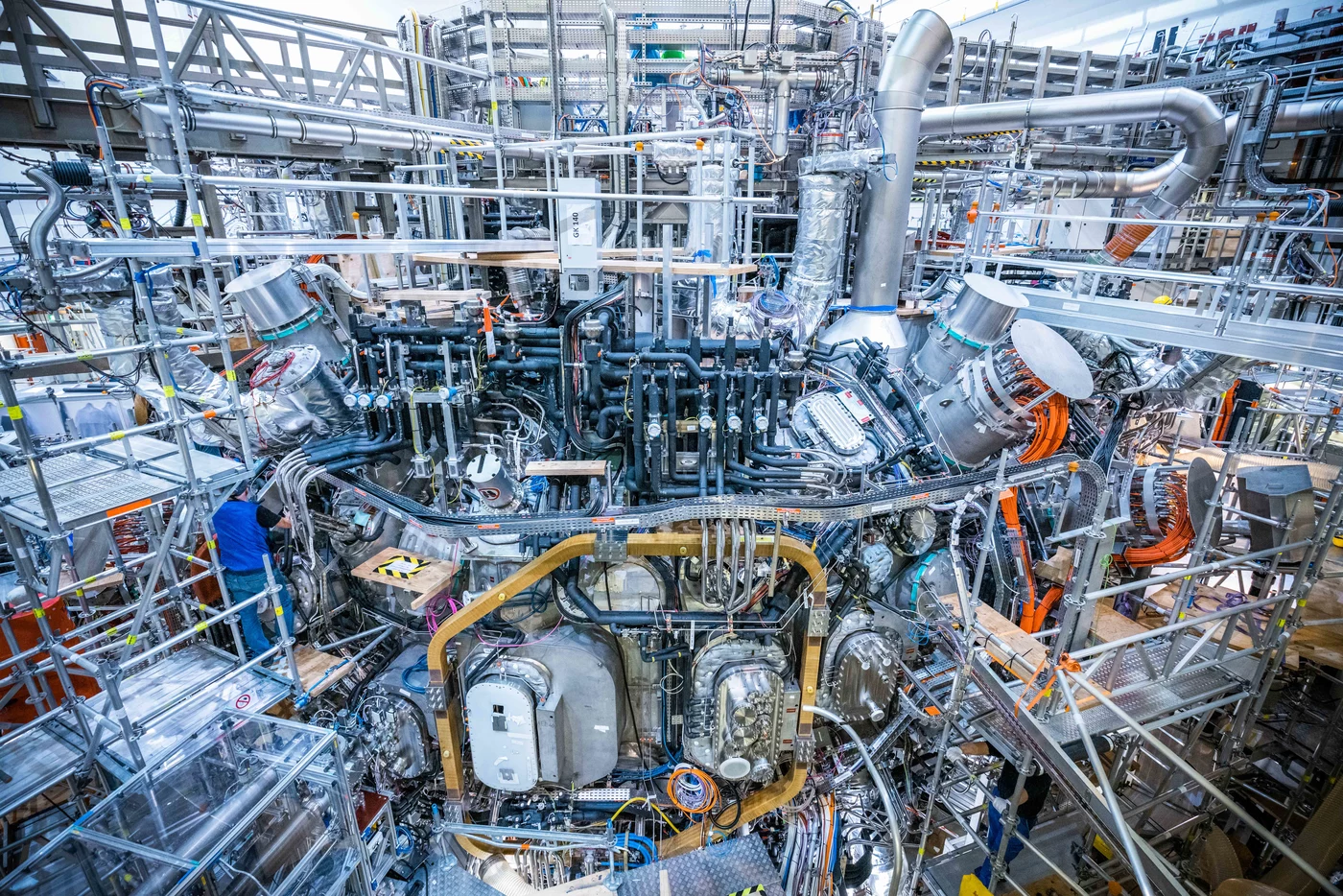
Wendelstein 7-X gave that mission its foundation. The €1.4 billion stellarator had met all of its design targets by 2022 and holds stable plasmas for half an hour at a time, proof that the stellarator's defining promise of continuous, disruption-free operation works in practice rather than only in simulation.
Proxima is now taking that result into industry - building Stellaris, the first peer-reviewed stellarator power plant concept to satisfy the demands of physics and engineering in a single coherent design.

The trillion-dollar thesis
When announcing our last fund generation, we spoke about Cherry's ambition to fund Europe's first trillion-dollar company. The race to commercial fusion is one of the few arenas where that outcome is seriously on the table. While the United States and China are committing capital to fusion at pace, Europe retains the strongest magnetic confinement ecosystem in the world, built over decades of research. Proxima is the company converting that inheritance into industrial position, with the state, the science and now the private markets aligned behind a single roadmap.
The first fusion company to matter will be the one whose machine can sell electricity around the clock rather than the one that produces net energy first in a laboratory. The stellarator is the architecture built for that possibility, running continuously and free of the disruptions that force tokamaks offline, which is why Proxima designed Stellaris around economics as a constraint rather than an afterthought - buildable with materials and supply chains that exist today.
The company is also vertically integrating the components where the value concentrates, expanding its own production of HTS cable and magnets, while Gundremmingen brings grid connection, cooling infrastructure and an experienced licensing environment that shortens the path from demonstration to revenue. On the demand side, the world's largest energy users see long-term strategic alignment with fusion's promise of clean, firm power for their future operations.
Proxima has spent three years earning its place at the front of Europe's effort - roughly 200 people across three countries, more than €650 million in total funding making it the best-funded fusion company in Europe, a peer-reviewed power plant design, and the Alpha Alliance, a consortium of more than 50 industrial partners preparing European supply chains for fusion at commercial scale.
Congratulations to Francesco, Lucio, Jorrit, Jonathan, Martin and the entire Proxima team. The first fusion power plant just got closer to reality.
.png)
.png)
