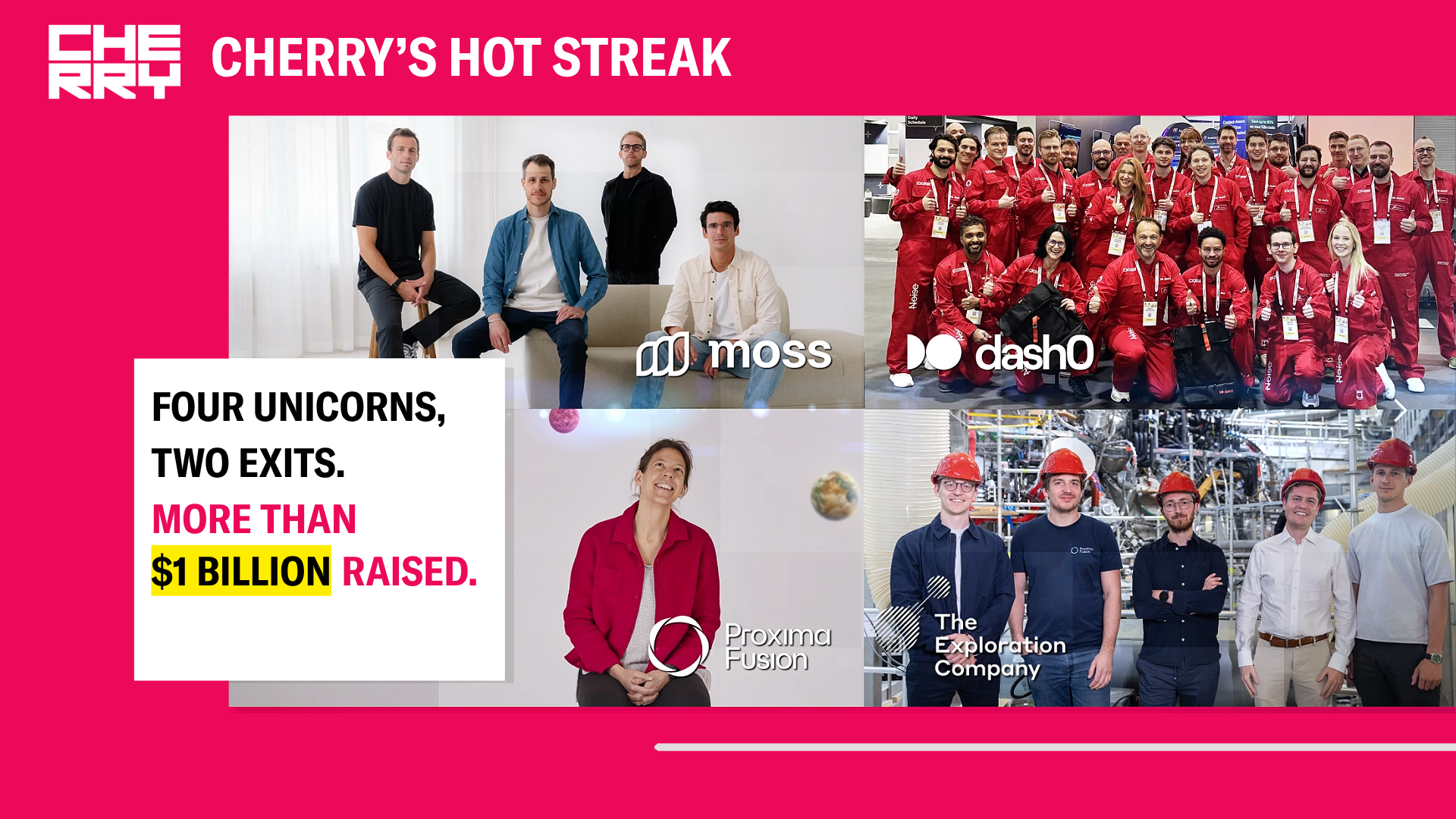
Every two years we clear the calendar, and bring our friends and supporters together. The day is built around our founders, the LPs who back us, and the co-investors we build alongside. This year that meant 500+ guests in London's Central Hall Westminster.
We run the summit because venture capital is fundamentally about people. There is a lot of content in the VC space, and while you can read or listen to podcasts about building, it becomes alive when founders are on stage explaining their story.
This year the summit kept circling one shift. For most of the last decade, the hard part of company building was building the thing: the engineering, the years to ship, the team you needed to reach a product. That part has eased. The hard part now is knowing what to build, and the day was our founders and guests working out what that means.
"We are in a new world where the limitation is no longer the software. The limitation is your own imagination and your own creativity." Varun Anand, Clay
Smaller teams, deeper builds
The mechanics are the easiest part to see, so start there.
Mirko Novakovic built dash0 as his third company in observability, a market with 20 players already in it. The reflex in a crowded market is to ship something small and iterate in public, instead he told the story of 18 months building first, on the reasoning that customers in a mature category already have a tool and will not switch for a prototype. He aimed for 100 customers in year one, finished at 500, passed 1 million in ARR by June, and now signs around 30 customers a week.

If dash0 shows the payoff for building deep in a crowded market, Light shows how far the cost of building has fallen. Jonathan Sanders set out to rebuild the ERP, the software category owned by Oracle, SAP and Microsoft, and the estimate he was handed was 10 years and $100M.
"We're gonna build a much easier to use AI-native version of Oracle and Microsoft, and most people told us that we were crazy. But then we went out and did it anyway."
Light reached a working product in roughly 2 years by hiring the ex-engineers from SAP, Workday and Microsoft, almost all of them in Europe, and building on what those teams had learned the hard way. The talent that built the last generation of enterprise software lives on the continent and is available to the people rebuilding it.
The leverage now reaches one person as readily as a team. Zaro came out of stealth on the morning of the summit with a $5.1 million pre-seed, and the demo featured a user who rebuilt his business operations in 2 hours by piping agents into his own workflow in plain language, no code involved. The argument underneath the demo is about ownership: your data and the record of how your business runs should belong to you rather than sit locked inside a vendor's product, rented back to you.
The build keeps getting cheaper, which only sharpens the question of what to build.
Knowing what to build
If the engineering is no longer the wall, the question becomes which wall replaced it. The founders gave a consistent answer, and it was not more data.
Mirko and Varun spent their fireside circling the same point. Varun argued that data tends to confuse as much as it clarifies, and that the asset that compounds is the founder's own read on the customer. Mirko put the discipline behind it in concrete terms:
"A customer can churn every day and that keeps you honest. You have to talk to the customer. You have to make sure they are happy."
Alex Oelling at INXM aimed the same instinct at the technology. The industry is spending its effort on more tokens, more intelligence, more raw capability. His company is built on a different bet:
"AI hasn't got to be smarter. It has to be more reliable to get the work done."
INXM holds the state of an LLM so that the same enterprise process, a SAP transaction running tens of thousands of steps, executes identically every time. For the work enterprises will pay for, a system that is right every time beats a system that is occasionally brilliant.
Milena Nikolic at Heywa Labs named a third constraint, the one that decides who keeps the customer.
As people move their discovery into general agents, brands lose the direct interface to the buyer, and with it the ability to influence anything beyond price. Heywa builds interactive, visual experiences brands own outright, so the relationship survives the shift to agents rather than dissolving into someone else's chat window.
Three answers to the same question.
The read on the customer, the reliability of the system, and ownership of the relationship. Those choices share a common engine, and several founders had it running on stage.
The agentic layer, in production
A run of the day was agents doing work that used to require people, with the infrastructure those agents demand once they are loose in a business.
Tano automates the hardest channel in marketing to systematize. Influencer outreach has never been programmatic, because, as Will Caplan mentioned, it is the one media type with feelings that takes three days to answer an email. Tano's agents vet, contract, negotiate and pay creators at scale. He proved it on the clock: in the 90 seconds he had been speaking, the system had contracted 37 creators around the world with no human in the loop.
Forgent applies the same model to tenders, which Timo Kuschma argues is the largest sales channel on earth and runs on paper and people. More than 40% of public tenders draw no bid or a single bid. Forgent's agents find the right tenders across hundreds of procurement portals and run each bid end to end. One Fortune 500 customer was confident it was missing nothing, then learned in a benchmark it had been missing 40% of high-fit tenders.
Once agents are running everywhere, someone has to account for them. Neal Swaelens built Manifold for that job, and opened on the question his customers could not answer:
"Do you know what your AI agents did last night?"
Manifold finds the agents running on enterprise endpoints, maps the supply chain beneath them, and blocks destructive commands as they happen. He was clear that this runs at scale across large organizations today rather than sitting on a roadmap.
The next wall is distribution
Once you know what to build and the leverage exists to build it, the constraint moves again, to getting it in front of the right buyers, which for a European company usually means the US. The panel on cracking that market was the most practical 25 minutes of the day. Max Junestrand of Legora described setting a hard bar before committing: sign two of the top 100 US law firms from Europe, then go. Carles Reina of ElevenLabs argued the US buyer is often less discerning than the ones in India or China, and that the move is to land any first use case, however small, to block a competitor and expand from there. The blunt version, again from Junestrand: if you are only big in the Nordics, you probably have not built a big company. Build where the talent is, sell where the market is.
Building the team that builds
All of that is the work changing: what you build, how you build it, where you sell it. The thing that does not change is the discipline of building a team that can ship any of it, which is why the talk founders quoted most came from someone who has never raised a round.

Jill Ellis won the World Cup twice as a coach. Her subject was high performance as a system: clarity, accountability, trust, and a standing refusal to coast. The line that traveled furthest:
"If you're the same leader today that you were four years ago, you're failing."
She was as precise about the contract between a leader and a team. She does not ask people to love their role, she asks them to execute it, and she puts the responsibility for whether they can on the leader: if they have not learned, you have not taught. For a room of founders scaling fast as their products turn over underneath them, it was the talk with the longest half-life.
The hard stuff counts too
Not every problem on stage was a software problem. BEO came to talk about what software runs on, grounding the AI conversation in a physical bill the room had been talking over. European companies pay roughly double what US and Chinese companies pay for energy, a gap running into the tens of billions a year. No dashboard closes it. BEO installs and finances large batteries, optimized by its Kronos AI, and returns customers around 20% in annual energy savings with zero capex.
"Without cheap power there's no AI, no innovation, no future worth competing for."
Robeauté is working at the other end of the difficulty spectrum, in medicine - building a micro-robot 1.8mm across that travels through brain tissue to diagnose, treat and monitor, an infrastructure layer for the one organ medicine has never reached.
Joanna Cartocci described it as a single innovation built to launch a thousand more.
The frontier, built here
The day's final panel put three of the most ambitious companies in Europe on one stage.
Hélène Huby founded The Exploration Company to build Europe's reusable space capsules to carry cargo and astronauts to space stations. The company has signed the first Space Act Agreement between a European firm and NASA, and Huby was blunt about why the gap is worth attacking: Europe pays SpaceX half a billion a year to fly its astronauts, and an Ariane launch runs 140 to 200 million against SpaceX's 70 million for the same payload. An order of magnitude sits in that gap, and someone has to close it.

Martin Kubie's Proxima Fusion is also chasing hard prizes, aiming for the first commercial fusion power plant, built on the W7-X stellarator at the Max Planck Institute, the only machine of its class ever built.
His case for doing it in Europe was not sentimental - the talent and the supply chain are concentrated on the continent, and Kubie was direct that the US and China are within a few years of an irreversible lead, to which Europe does not want to be a spectator.
Likewise, Helsing's Torsten Reil carried the panel's sharpest argument about the continent itself. He was tired of the assumption that Europe cannot build large companies with global ambition, and refused the usual excuses about regulation and capital, both solvable in his telling. He was as willing to name where Europe is still falling short: no founding team has stepped up to build a humanoid robotics company at scale, and the funding for one is there for the taking.
"We've already missed the train on AI and on frontier models. We're about to miss it again if we're not careful on robotics. No one else to blame. It's just us."
Where this leaves us
The pace of change in technology has never been this fast. That speed is why we put everyone in one room rather than send a memo. For a day, the founder rebuilding the ERP compares notes with the founder securing the agents, the fusion founder and the space founder discover they are making the same argument, and a World Cup coach resets how a few hundred founders think about the people they lead. And in between the sessions, the part no agenda captures: founders meeting their follow-on investors, operators meeting their next company, and introductions that would never have happened over email.
We're already looking forward to the next Summit!
.png)